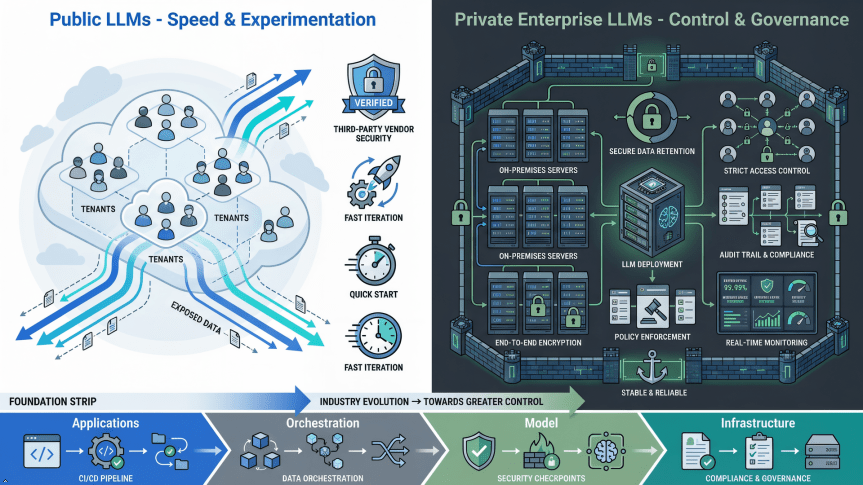
If you look back at how large language models have evolved, it feels a lot like watching the early days of cloud computing on fast-forward. At first, it was all demos and wow moments. Public chat tools, quick prototypes, lots of excitement. Everyone was trying things out and seeing what stuck.
Then reality set in.
As LLMs started creeping into real workflows like writing internal docs, answering customer questions, and touching production data, the cracks became harder to ignore. The consumer-style setup that made early experimentation so easy was never designed for the kind of control, security, and accountability businesses actually need.
Today, LLMs are crossing a line. They are no longer side experiments or productivity hacks. They are becoming part of core enterprise infrastructure, and that changes how companies think about them.
This is the story of that shift. Why it is happening, what it means architecturally, how the ecosystem is responding, and the tough choices tech leaders are now being forced to make.
What the Market Is Really Saying
If anyone still thought enterprise AI was mostly hype, the spending data makes that hard to argue. Enterprise investment in LLMs more than doubled in the first half of 2025, jumping from about $3.5 billion at the end of 2024 to over $8.4 billion just six months later. That kind of growth does not come from curiosity. It comes from teams putting models into production.
What is just as interesting is how that spend is spreading out. Early on, one or two providers dominated the conversation. Now usage is fragmenting. Anthropic models, for example, account for roughly a third of enterprise LLM usage in production environments, with other major players close behind.
That shift says a lot. Companies are no longer chasing the single “best” model. They are choosing platforms that fit their risk tolerance, their data constraints, and their long-term architecture. LLMs are not being adopted because they are trendy. They are being adopted because, when deployed the right way, they become hard to live without.
The Real Difference Is Not the Model, It Is the Architecture
Under all the buzz, the enterprise transition comes down to one simple idea. Where the model runs matters just as much as what the model can do.
Public LLMs: Easy, Fast, and Limited
Public APIs were the perfect entry point. You could build something in an afternoon. No GPUs to manage, no scaling decisions to stress over, no infrastructure to maintain. For early teams, that felt like magic.
But that convenience comes with tradeoffs. Public LLMs run in shared environments. Data moves through systems you do not control. Even with strong contracts and promises around non-retention, that setup often clashes with internal policies, regulatory expectations, and basic security instincts.
At some point, teams hit a wall. Not because the model is not capable, but because the environment around it is not built for serious production use.
Private LLMs: Bringing AI Inside the Fence
Private LLM deployments turn that setup inside out. Instead of sending sensitive data out to a public service, the model is brought closer to the data. It runs inside a private cloud, a dedicated tenant, or sometimes on-prem hardware. Identity, networking, logging, and access control work the same way they do for every other critical system.
That is the real unlock.
Once the model lives behind your firewall, it starts to feel familiar. It plugs into IAM, follows zero-trust rules, emits audit logs, and fits into existing governance. Conversations change at that point. Teams stop debating whether AI is “safe” and start asking how to scale it responsibly.
The focus also shifts. Instead of obsessing over benchmarks, people care about data flow. Where context comes from. Who can see outputs. How prompts are logged. What happens when something goes wrong. These are not glamorous questions, but they are exactly the ones that matter in production.
How the Enterprise AI Ecosystem Is Adapting
As this shift became obvious, vendors adjusted quickly.
OpenAI’s enterprise offerings, especially through Azure OpenAI Service, lean heavily into private networking, compliance tooling, and tight integration with existing identity systems.
Anthropic’s Claude for Enterprise has found a strong audience among teams that care deeply about safety, predictable behavior, and controlled interactions. It feels less like a chatbot and more like a careful collaborator, which matters in regulated environments.
AWS Bedrock takes a different path. It gives companies access to multiple foundation models and lets them run everything inside their own VPCs. Model choice and governance stay with the customer.
Google Cloud’s Vertex AI focuses on tying LLMs into a broader MLOps story, making it easier to fine-tune, deploy, and monitor models alongside existing ML systems.
Across all of these platforms, the message is consistent. Enterprises want strong models, but not at the cost of giving up control.
This Shift Changes More Than Technology
Moving to private LLMs is not just an architectural decision. It reshapes how organizations operate.
AI tools that once lived in individual teams are now pulled into central governance. Security teams want clear audit trails. Legal teams care about where data lives and how it is handled. Engineering leaders begin to think of LLMs the same way they think about databases or internal APIs.
Vendors feel this pressure too. Enterprise buyers are not looking for flashy weekly updates. They want stability, clear upgrade paths, and the ability to switch models without rewriting everything. Long-term thinking starts to matter again.
Different Company Sizes, Different Realities
Startups walk a tightrope. AI can be a huge accelerator, but building a full private LLM stack too early can slow things down. The teams that do this well usually ease into it. They start with managed private endpoints, wire in identity early, and save deeper customization for later.
Mid-market companies sit somewhere in the middle. They have real compliance needs, but not always the platform teams to support heavy customization. For them, cloud-native private offerings often hit the sweet spot. Enough control to stay safe, without taking on massive operational overhead.
Large enterprises treat this as a platform decision. They build central AI teams, define reference architectures, and roll out shared services that business units can plug into. For them, private LLMs are infrastructure, on par with Kubernetes or identity systems.
What This Means for Tech Leaders
The big takeaway is simple. This is not about chasing AI trends. It is about making sound architectural decisions.
Start with your data. Let security and governance shape where models run and how they connect to internal systems. Build things in a modular way so you can evolve as models change. And think long-term, because once AI is woven into core workflows, it is hard to unwind.
The companies getting this right are not moving the fastest. They are moving deliberately.
Closing Thought
The move toward private, custom LLMs is not a rejection of public AI. It is a sign that AI is growing up.
As LLMs become part of the backbone of modern businesses, they are being held to the same standards as every other critical system. The organizations that see this shift as an investment, not a burden, are the ones most likely to turn AI into something durable, trusted, and genuinely transformative.
If you want, I can tighten this even more, tune it for a specific audience like founders or security leaders, or smooth it further to sound more like a personal blog than a tech publication.

 THE NUCLEAR GEEKS