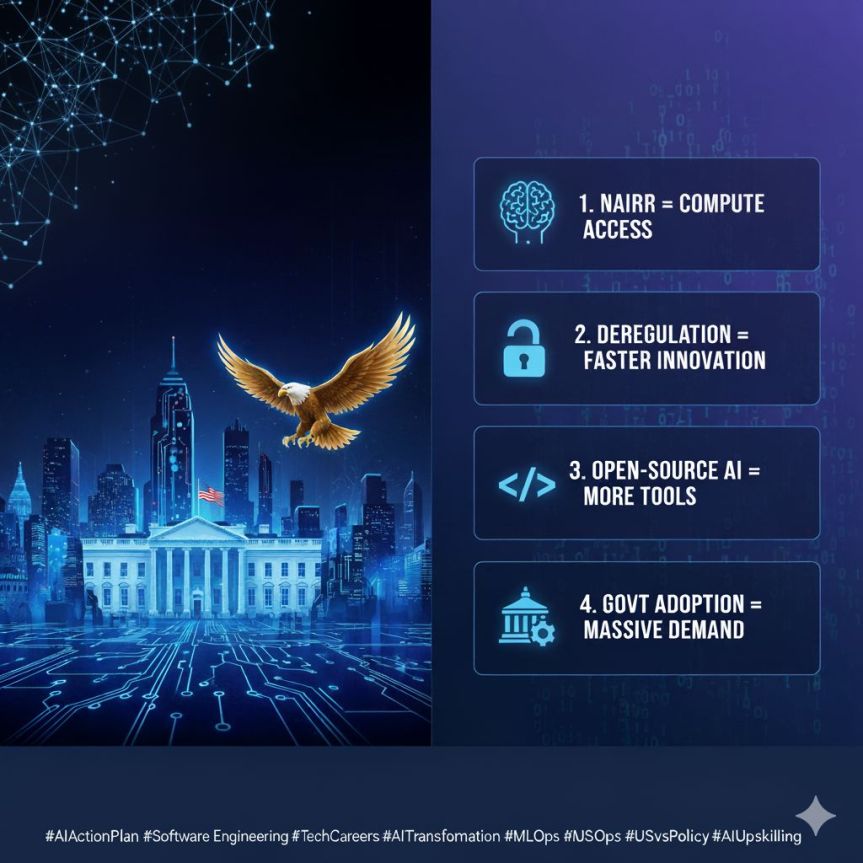
I. Executive Synthesis: Defining America’s “Golden Age” Mandate
The White House’s “America’s AI Action Plan” represents a decisive, strategic pivot in U.S. technology policy, establishing a national framework intended not merely to foster innovation but to aggressively secure global dominance in artificial intelligence. The plan, structured around the three pillars of Accelerating Innovation, Building AI Infrastructure, and Leading International Diplomacy and Security , seeks to usher in a new era of technological achievement and economic competitiveness for the American populace.
For the specialized engineering workforce, this mandate is not just policy; it is a direct mechanism for market acceleration. The policy creates immediate, high-value opportunities by simultaneously injecting unprecedented resources into research infrastructure while establishing clear, security-driven standards that mandate specific, high-paying skill sets.
However, the prevailing narrative of complete market deregulation requires immediate clarification. While the plan champions market acceleration and rescinds certain preceding executive actions , the underlying reality is a strategic, dual-track governance system. This approach mandates hyper-acceleration in foundational research and commercial deployment while imposing increasingly strict security and compliance guardrails, particularly in high-stakes environments such as federal procurement and national security systems. Critics correctly point out that it is hard to justify a completely hands-off stance on societal harms when Washington intervenes so readily on the supply of advanced computing chips for national security purposes. This strategic contradiction means the highest value is now placed on engineers who can navigate both high-velocity open innovation and rigorous, high-security compliance engineering environments. The economic roadmap is being redrawn by policy, creating a highly lucrative scarcity of talent equipped to meet these complex technical and governance demands.
II. Pillar I: The Infrastructure Revolution—Democratizing Compute via NAIRR
The core mechanism for realizing the Action Plan’s infrastructure goals is the establishment of the National Artificial Intelligence Research Resource (NAIRR). This initiative is designed to bridge the gap faced by many researchers and educators who lack access to the requisite AI resources—including computation, data, software, models, training, and educational materials—needed to fully conduct their activities and train the next generation of professionals.
2.1 The Mechanics of NAIRR: From Pilot to Sustainable Operations
The current phase is characterized by the NAIRR pilot, a proof-of-concept led by the U.S. National Science Foundation (NSF) in robust partnership with 13 other federal agencies and 28 nongovernmental contributors. The pilot is focused on supporting fundamental, translational, and use-inspired AI-related research, with a particular emphasis on societal challenges. Insights gleaned from this phase will be critical for refining the design of the eventual full-scale NAIRR.
The long-term vision calls for the establishment of the NAIRR Operations Center (NAIRR-OC), which will serve as a lean, sustainable operational capability. This center will be the foundational focal point responsible for the visioning, coordination, operations, and development activities necessary to maintain an integrated national infrastructure for AI research and education. The NAIRR-OC is tasked with setting the operational framework, organizational management, and success metrics in alignment with the goals established by the NSF and other federal partners.
2.2 Access and Allocation: Translating Policy into Compute Time
The democratization of compute access, often cited as a game-changer for startups and developers, is operationalized through a clear resource access mechanism. Researchers discover and access NAIRR pilot resources through the dedicated NAIRR pilot portal (nairrpilot.org). Certain resources, such as open datasets and open models, are readily available upon accessing the portal. However, access to high-demand computational resources, such as dedicated GPU clusters or API access to specialized models, requires researchers to apply through a coordinated allocation process. This structured approach ensures that resources are directed toward accelerating AI and AI-powered discovery, expanding the AI workforce, and increasing the use of world-class public and private-sector AI assets.
The policy decision to integrate private sector capabilities into a federally managed resource acts as a strategic market distortion tool. By providing access to proprietary compute stacks, the plan ensures that the next generation of American AI talent gains hands-on experience with cutting-edge hardware and cloud platforms that would otherwise be inaccessible due to prohibitive capital costs. This cultivates a generation of AI researchers and engineers fluent in vendor-agnostic development across major commercial and specialized ecosystems.
2.3 The Compute Stack: Leveraging Public-Private Partnerships
The promise of unprecedented compute access is fulfilled through significant public-private partnerships. Private sector contributions are vital, offering resources that accelerate the training and deployment of complex machine learning models.
Major contributors include:
- Amazon Web Services (AWS): Providing credits for storage, compute, and AI services, supporting a significant number of research projects. AWS also contributes access to pre-trained and customizable AI/ML models and makes hundreds of datasets available through the Registry of Open Data on AWS.
- Cerebras: Offering access to their advanced systems and clusters, contributing up to four EXAFLOPs of AI compute power for NAIRR pilot projects. Furthermore, Cerebras contributes open-source datasets, models, and the time of its expert data scientists to ensure project success.
Beyond compute, federal agencies contribute rich, domain-specific datasets essential for targeted AI research. The U.S. Patent and Trademark Office (USPTO) provides rich datasets for AI training and supports public challenges, while the USGS contributes datasets vital for model development in areas such as environmental science and infrastructure planning.
2.4 The Secure AI Imperative (NAIRR Secure)
A critical component of the infrastructure buildout focuses on security and privacy. The NAIRR Secure pilot, co-led by the National Institutes of Health (NIH) and the U.S. Department of Energy (DOE), supports research requiring strict privacy and security-preserving resources.
The NAIRR Secure project is assembling exemplar privacy/security-preserving resources, including secure compute resources, data enclaves, and privacy-preserving tools. Goals for this pilot phase include investigating novel opportunities for combining data securely and exploring challenges related to the interoperability of tools and software between the NAIRR Secure enclaves and the open NAIRR environment. This infrastructure is foundational for high-trust sectors such as national defense, healthcare, and finance, ensuring that sensitive regulated data can be utilized for advanced AI research without compromising privacy or security protocols.
| Table 1: NAIRR Pilot Resource Map and Access Mechanisms |
| Resource Type |
| Computation (High-Performance) |
| Datasets (Open/Proprietary) |
| Secure Computing |
III. Pillar II: Navigating the Dual-Track Governance Landscape
The policy environment mandated by the AI Action Plan is fundamentally dual-track, balancing aggressive innovation acceleration with stringent accountability and trust requirements. This environment necessitates that engineers adopt a structured, standards-aligned approach to development, making regulatory expertise an increasingly essential technical skill.
3.1 The Myth of Complete Deregulation
The plan promotes streamlined adoption and removed barriers to deployment. However, this “deregulation wave” narrative is tempered by the national security and ethical mandates embedded in the policy. The U.S. governance model operates along two strategic lines: one focused on broad commercial innovation and open competition, and another focused specifically on mitigating high-consequence risk in federal and defense applications.
Crucially, the government readily intervenes in the supply chain (via export controls) when national security is at stake, making a completely hands-off approach to governance demonstrably false. While the administration has sought to prevent perceived ideological bias in government AI procurement , the simultaneous push for trustworthiness requires structured governance.
3.2 Pro-Innovation Track: Open Source and Sandboxing
The plan explicitly aims to accelerate innovation through open-source promotion. It includes a specific section titled “Encourage Open Source and Open Weight-AI,” which is led by the National Telecommunications and Information Administration (NTIA). This policy seeks to democratize AI development, ensuring that academics, developers, and startups have broader access to models, tools, and opportunities for building and iterating.
Furthermore, the Action Plan recommends the use of regulatory AI sandboxes. These environments allow AI tools to be deployed and evaluated under controlled conditions, with results shared openly, enabling faster regulatory feedback loops without imposing stifling, pre-emptive rules on the broader market.
3.3 The Security and Trust Track: Mandatory Compliance via Procurement
The primary mechanism for enforcing responsible AI practices is leverage through federal procurement and spending power. This centers on the National Institute of Standards and Technology (NIST) AI Risk Management Framework (AI RMF).
3.3.1 The NIST AI RMF as a Foundational Standard
The NIST AI RMF is a guidance document developed in collaboration with both the private and public sectors. It provides a systematic, voluntary approach for organizations designing, developing, deploying, or using AI systems to manage risks. The framework emphasizes the need for transparency, accountability, and ethical behavior, built upon four fundamental functions: Govern, Map, Measure, and Manage. It addresses the unique “socio-technical” nature of AI risks, which can emerge from the interplay of complex societal dynamics and technical vulnerabilities, including bias, privacy violations, and security gaps. The framework’s adaptability allows organizations of all sizes and across various industries to tailor its principles to their specific risk profiles.
3.3.2 Enforcing Compliance through Federal Demand
Although the NIST AI RMF is voluntary for the general industry , it is becoming a de facto required compliance standard for any entity seeking lucrative government contracts or operating in highly regulated sectors. The federal government is a massive early adopter of specialized AI systems, and its procurement decisions fundamentally dictate industry standards.
The U.S. General Services Administration (GSA) launched USAi, a secure generative AI evaluation suite that enables federal agencies to experiment with and adopt AI at scale. This platform delivers mission-ready tools, such as chat-based AI and code generation, to government users within a trusted environment that is explicitly standards-aligned. This infrastructure, described by GSA as critical for America’s AI future , accelerates AI adoption while adhering to security standards like moderate Federal Information Security Modernization Act (FISMA) requirements.
Furthermore, contracts across the defense and civilian spheres explicitly mandate compliance. Federal contractors, including those working for the Department of Defense (DoD) and the Department of Veterans Affairs (VA), must demonstrate adherence to the NIST AI RMF and associated ethical principles. This immediate demand requires personnel who understand both AI technical implementation and federal risk management frameworks, capable of conducting AI risk assessments, implementing transparent model governance, designing validation protocols, and documenting decision-making processes for accountability. Failure to integrate these practices early in the AI lifecycle can jeopardize a system’s ability to mitigate cybersecurity risks and impact its operational use.
IV. Pillar III: Global Leadership and the Geopolitical Choke Point
The third pillar of the AI Action Plan is driven by the geopolitical competition for global AI dominance, particularly against China. The strategy centers on leveraging export controls to limit rival capabilities while simultaneously accelerating domestic innovation.
4.1 The Strategy of Advanced Export Controls
The U.S. government, primarily through the Bureau of Industry and Security (BIS), has implemented a series of stringent export controls targeting advanced computing chips and semiconductor manufacturing equipment (SME). These actions are designed to achieve two strategic objectives: first, to immediately impair Chinese capabilities in AI and supercomputing by cutting off access to high-end chips (such as the A100 and H100, and later the A800 and H800) ; and second, to prevent China from designing and manufacturing its own advanced devices by blocking access to necessary Western design tools and chipmaking equipment.
This strategy is a direct intervention aimed at ensuring that the U.S. maintains the technological lead necessary to set global standards and reap the broad economic and security benefits of AI.
4.2 The Hidden Engineering Cost: Innovation in Reverse
While effective in slowing immediate advances, the export controls impose a significant, often overlooked, technical cost on American engineering firms. The continuous tightening of control thresholds forces U.S. companies to focus R&D resources on “compliance engineering.” Companies like Nvidia have been compelled to design “crippled” China-only variants (such as the H20, L20, and B30) that intentionally sacrifice capability to fall below the export thresholds.
This process involves innovation running in reverse: engineers spend time capping product capabilities rather than advancing them, effectively turning engineering development into a compliance exercise. This diversion of technical talent and R&D capital represents a hidden tax on US industrial competitiveness. Furthermore, the loss of substantial revenues from the curtailment of China sales reduces the capital available to U.S. firms, capital that is critical for funding the exceptionally high levels of research and development required to maintain a lead in the semiconductor industry. Nvidia’s CEO estimated the total revenue loss from the H20 export blockage alone could reach $15 billion, a figure that far exceeds the company’s entire $8.68 billion R&D budget for FY 2024.
4.3 Accelerating Chinese Substitution and Rivalry
The geopolitical strategy trades short-term containment for the long-term acceleration of Chinese technological self-sufficiency. The implementation of export controls, while initially disrupting China’s ecosystem , has also spurred an “all-out, government-backed effort” to improve domestic self-sufficiency in chip design and production.
This concerted national effort has already resulted in startling achievements by Chinese competitors. For instance, Huawei’s Ascend AI chips (such as the 910D) are rapidly advancing and are anticipated to rival or surpass Nvidia’s flagship H100. As a result, Nvidia’s market share in the Chinese AI chip market has already plummeted from an estimated 95% to 50%. This demonstrates that while the controls impose short-term pain, they act as a potent catalyst for accelerating Chinese domestic substitution, forcing the U.S. to continually innovate at a pace that overcomes not only external competition but also the imposed constraints on its own global market access.
| Table 2: Impact Analysis of Key US AI Export Controls (2022-2025) |
| Control Target |
| Advanced Logic Chips (e.g., H100, A800) |
| Semiconductor Manufacturing Equipment (SME) |
| Impact Analysis of Key US AI Export Controls (2022-2025) |
V. The Exploding Engineering Economy: Career Roadmaps and Upskilling
The policy-driven demand signal from the AI Action Plan guarantees massive demand for AI-skilled engineers across all sectors, particularly those intersecting with federal requirements and high-scale infrastructure. The engineering economy is currently experiencing explosive growth centered on four high-value career paths.
5.1 The Federal Demand Signal: Government as a Tech Client
The government’s commitment to accelerating AI adoption is translating into substantial contract opportunities and a surging internal demand for talent. The launch of GSA’s USAi platform is a direct manifestation of this strategy, enabling the federal workforce to safely and quickly experiment with and adopt generative AI, including code generation tools. This modernization effort requires external technical support for integration, customization, and secure deployment.
Federal agencies, including the U.S. Army, are actively seeking industry and academic expertise for AI/ML solutions, such as automating declassification processes. Furthermore, the modernization of the federal acquisition process itself involves automating contract analysis and cost estimation using AI and Natural Language Processing (NLP) tools, creating a need for specialized engineers to manage the associated risks and requirements.
5.2 MLOps and AI Infrastructure: The Critical Linchpin
The rise of MLOps (Machine Learning Operations) has moved beyond a niche discipline to become the critical linchpin for production-grade AI systems. MLOps standardizes the entire lifecycle, from data preparation and model training to deployment and continuous monitoring, ensuring that AI systems remain reliable, reproducible, and effective at scale.
The market recognizes that without robust MLOps practices, even the most innovative AI models fail to deliver value to the end user. This convergence of factors—cross-industry AI adoption, evolving tooling (e.g., Kubeflow, MLflow), and a short supply of qualified candidates—has fueled a thriving job market. Compensation for ML and MLOps roles has seen year-over-year jumps of approximately 20%, with total compensation for seasoned candidates often reaching between $200,000 and $400,000 or more.
The primary engineering challenge in MLOps is making models production-grade, focusing on core components such as data/feature pipelines, controlled releases, deployment infrastructure, continuous monitoring for performance drift, and strict cost optimization.
5.3 The Rise of High-Security AI Systems (Compliance Engineering)
The Action Plan’s focus on high-security systems, particularly within the DoD, VA, and Intelligence Community, has created an urgent demand for a new specialization: AI Risk and Compliance Engineering. This role merges advanced ML knowledge with mandated governance frameworks.
The Department of Defense (DoD) has prioritized integrating cybersecurity risk management activities throughout the entire AI lifecycle, consistent with policy requirements like DoDI 8510.01. This mandates that federal contractors staff projects with professionals who can:
- Conduct Risk Assessments: Aligning with the NIST AI RMF criteria.
Implement Governance: Ensuring transparency and explainability in model outputs.
Design Testing Protocols: Validating the safety and reliability of AI systems.
Monitor Deployment: Continually tracking systems for security vulnerabilities, bias, and data/model drift.
The federal government’s structured move toward mandatory risk management means that high-growth areas for senior engineers are shifting strategically from pure model development to expertise in secure deployment, operational governance, and accountability systems.
5.4 AI-Assisted Coding and Application Development
The democratization of models through open-source initiatives and the deployment of generative AI tools within federal agencies, such as GSA’s USAi , directly stimulate demand for engineers skilled in leveraging these systems.
Engineers must transition their skills to focus on integrating large language models (LLMs) into end-to-end applications. This includes specializing in LLM fine-tuning techniques (like LoRA/QLoRA), ensuring robust data governance, and implementing rigorous evaluation methodologies, including A/B testing and offline/online evaluation. The ability to rapidly build reliable AI applications that enhance human well-being and augment collective capabilities is a direct goal of the plan.
5.5 NSF Workforce Development Programs: Federal Upskilling Investment
The Action Plan recognizes that winning the AI race requires building a world-class domestic workforce. The NSF is preparing AI-capable innovators by investing over $700 million each year in various programs. These investments focus on creating educational tools, materials, curricula, scholarships, and fellowships designed to equip educators and practitioners with the skills needed to contribute to an AI-driven economy. This federal funding provides crucial, formalized pathways for the existing engineering workforce to upskill in areas critical for U.S. global leadership and economic competitiveness.
| Table 3: High-Value AI Engineering Roles Driven by the Action Plan |
| Career Path |
| MLOps/Platform Engineer |
| AI Risk/Compliance Engineer |
| AI Application Developer |
VI. Strategic Recommendations for the AI-Ready Engineer
The “America’s AI Action Plan” has created a clearly defined, policy-mandated trajectory for the engineering profession. Success in this new landscape depends on strategic upskilling that prioritizes production maturity and compliance assurance over mere experimental development.
6.1 Capitalizing on Federal Infrastructure Access
Engineers, particularly those in startups, academia, and small research groups, should immediately investigate the NAIRR allocation process. This infrastructure represents a strategic subsidy, offering access to high-end compute (including Cerebras EXAFLOPs) and rich datasets (USPTO, USGS) that would otherwise require massive private capital investment. Specializing in the NAIRR Secure pilot offers a highly differentiated skill set in managing privacy-preserving resources, which is crucial for entry into confidential and sensitive research domains, such as health and defense applications.
6.2 Prioritizing Production and Governance Expertise
The highest-value career opportunities are shifting to MLOps, security, and governance. Engineers must prioritize proficiency in operationalizing AI models reliably at scale. This requires formalized training in MLOps processes, disciplined version control for data and models, and clear ownership of system uptime and cost metrics.
Furthermore, technical proficiency in governance is now mandatory for high-value contracts. Engineers should master the NIST AI RMF functions—Govern, Map, Measure, and Manage—and be capable of integrating these principles into the continuous integration/continuous deployment (CI/CD) pipeline. The ability to demonstrate and document compliance with transparency, accountability, and fairness standards is no longer a soft skill; it is a technical prerequisite for working in critical sectors.
6.3 Navigating the Politicized Supply Chain
Engineers working in chip design, supply chain optimization, or hardware integration must recognize that every technical decision is now imbued with geopolitical risk. The U.S. policy explicitly dictates the operational capabilities and market reach of advanced semiconductor products. 1 While export controls aim to slow competitors, they simultaneously accelerate rival domestic efforts, as evidenced by the rapid rise of chips like the Huawei Ascend 910D. 2 American engineers must focus on aggressive, performance-driven R&D that maintains a significant performance gap, offsetting the revenue losses and compliance burdens imposed by the current export regime. Continuous, high-velocity innovation remains the only viable strategy for sustained U.S. global leadership.

 THE NUCLEAR GEEKS