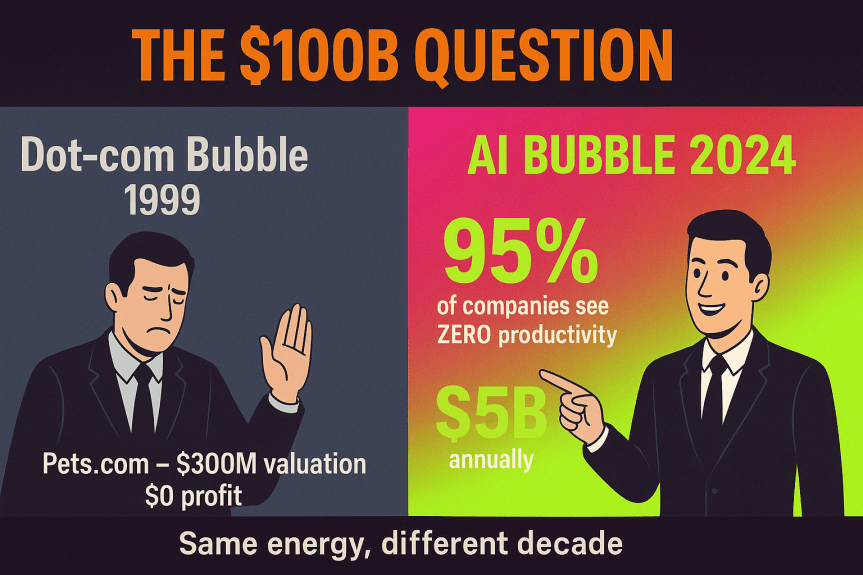
The air crackles with a familiar, yet uniquely intense, excitement. Talk of revolutionary technology, unprecedented market valuations, and the dawn of a new era fills boardrooms and investment headlines. We are witnessing one of the fastest and largest technological adoption cycles in history: the rise of Artificial Intelligence, particularly generative AI. But beneath the surface of this seemingly unstoppable boom, a question whispers with increasing urgency: Are we in an AI bubble?
With over $100 billion pouring into AI investments annually from venture capital and corporate war chests, the stakes couldn’t be higher. This intense debate mirrors, yet critically differs from, the infamous dot-com bubble of the late 1990s and early 2000s. Back then, companies with little more than a “.com” suffix and purely speculative business plans soared to astronomical valuations before crashing back to Earth in a spectacular correction.
Today, AI’s promise is transformative, but so too are the financial and operational warning signs. To navigate this landscape, we must delve into both sides of the argument: the robust bull case for AI’s enduring, foundational impact, and the sobering bear case that suggests a major correction or a selective “burst” is on the horizon.
🐂 The Bull Case: A Foundation Built on Giants
The most compelling argument against the “AI bubble” claim rests on the financial and technological foundation driving the current boom. Unlike the ephemeral startups of the dot-com era, the AI revolution is largely funded and driven by established, profitable technology titans.
Financial Fortitude: Profits Over Pure Speculation
The primary difference between now and 2000 is the financial underpinning of the industry’s leaders. Companies like Microsoft, Google (Alphabet), Amazon, and Meta are not relying on speculative venture capital or accumulating mountains of debt to fund their AI ambitions. Instead, they are pouring billions from their vast cash reserves and record-breaking quarterly profits into AI research, development, and deployment.
For example, a modern-day titan like Microsoft consistently reports net incomes exceeding $20 billion per quarter. They have the financial muscle to sustain long-term, high-risk investments in AI without jeopardizing their core business. This stands in stark contrast to the Pets.coms of the dot-com bubble, which, despite a $300 million valuation, had zero profit and relied entirely on speculative investor enthusiasm for survival. Today’s AI leaders command “fortress balance sheets” that enable them to treat massive AI expenditure as a strategic reinvestment, not a desperate gamble.
Immediate and Tangible Utility: Solving Problems Today
The internet of the late 1990s was full of promise, but its utility was still nascent. It struggled to stream video, cloud storage was nonexistent, and mobile internet was decades away. Today, AI is delivering immediate, practical utility to millions worldwide.
- Millions use ChatGPT and Claude for instant research and drafting.
- GitHub Copilot is demonstrably accelerating software development by up to 55%, saving companies time and money right now.
- AI-powered tools are automating customer service, personalizing commerce on Amazon, and optimizing logistics.
AI is not a promise of future value; it is a tool actively saving businesses time and money now. The underlying demand is not just speculative; it’s driven by tangible efficiency gains that are already beginning to show up in overall labor productivity statistics, mirroring the significant productivity acceleration that followed the initial internet bust.
Infrastructure Advantage: Building on Solid Ground
The current AI boom is not happening in a vacuum; it is standing on the shoulders of giants. The underlying foundation is robust:
- Global Cloud Computing: Decades of investment by Amazon (AWS), Microsoft (Azure), and Google Cloud have created a secure, scalable platform.
- Powerful GPU Clusters: The foundational work of companies like Nvidia has created specialized hardware for parallel processing, a perfect fit for deep learning.
- Existing Software Innovation: AI builds on mature operating systems, programming languages, and a global developer ecosystem.
If an individual AI project or startup fails, the underlying infrastructure, the servers, the chips, the data centers, and the core algorithms remains immensely valuable and reusable. This is fundamentally different from the dot-com era, where the failure of a company often meant the immediate obsolescence of its highly customized, proprietary system.
Corporate Stability and Long-Term Vision
The involvement of trillion-dollar companies with global infrastructure ensures that the AI investment cycle can sustain itself over the long term. Unlike desperate dot-com startups that faced an existential crisis with every market downturn, Microsoft can sustain multi-year, multi-billion-dollar investments in OpenAI (and its own in-house AI teams) because it views AI as a foundational technology that will permeate its entire product suite (Office, Azure, Windows). This long-term, patient capital provides a stability that simply did not exist in the 1990s.
🐻 The Bear Case: The Gold Rush Paradox
Despite the robust financial backing, a host of warning signs suggest that the current valuations of many pure-play AI companies are unsustainable and that the overall market excitement is veering into bubble territory.
The AI Productivity Paradox: Money Spent, Gains Unseen
Perhaps the most troubling evidence for the bear case is the “AI productivity paradox.” While companies are pouring capital into AI, they are not seeing commensurate returns on the bottom line.
- Zero Impact: Studies from major consulting firms suggest that while nearly eight out of ten companies have deployed or are piloting generative AI, just as many report no significant bottom-line impact.
- FOMO-Driven Spending: Many corporations rushed into AI from Fear Of Missing Out (FOMO) rather than a genuine, well-researched business need. This results in companies trying to force-fit AI into existing, inefficient workflows, leading to wasted expenditure and disappointing results.
- The Transformation Lag: Economists argue that truly transformative technologies, like electricity or the personal computer, require decades of organizational restructuring (re-engineering workflows, training new employees) before their full productivity benefits are realized. Companies expecting instant 10x gains are being disappointed, a classic bubble-era expectation.
Massive Structural Unprofitability: Selling Shovels vs. Mining Gold
The economics of running large language models (LLMs) are currently catastrophic for many. The only company consistently and spectacularly profitable is Nvidia, which manufactures the essential chips (the “shovels”) needed to train and run the models.
- Cash Burn Leaders: Companies like OpenAI reportedly lose money on every single ChatGPT query due to the enormous computing and electricity costs required to power its models. Despite annualized revenue reaching into the double-digit billions, their cash burn rate is projected to be in the billions annually, driven by R&D and infrastructure costs.
- The Margin Squeeze: Unlike traditional software companies with near-zero marginal cost, the gross margins of AI companies are structurally constrained by high variable compute costs. Even with millions of paid subscribers, achieving a clear path to sustainable profitability remains an enormous challenge. Anthropic and other major model developers face the same structural headwind.
Circular Funding Concerns: The Money-Go-Round
A significant risk in the current AI ecosystem is the presence of circular funding schemes, where the same capital cycles through the system, creating an illusion of demand and external profit.
- The Nvidia-Ecosystem Loop: Nvidia may invest in a specialized cloud provider (a “neocloud”) or an AI startup like OpenAI. That neocloud/startup then raises more debt or equity, and the primary use of that capital is to buy Nvidia’s expensive GPUs. Nvidia books this as revenue, which validates its high stock price, which in turn justifies its ability to make more investments.
- The Cloud Credit Shuffle: Deals like Oracle’s multi-billion dollar cloud deal with a major AI player often involve complex arrangements where money is essentially shuffled around the ecosystem to secure chip supply and infrastructure capacity, rather than being a straightforward exchange for external, profit-generating services.
If investor sentiment or macro conditions suddenly force a halt to this massive capital flow, the entire highly-leveraged ecosystem, where demand is subsidized by investments, could face an immediate collapse.
Market Concentration and Systemic Risk
The current market rally is narrow, concentrated in a handful of AI-heavy companies. This creates a systemic risk for the broader economy.
- S&P 500 Concentration: A small number of tech companies, often dubbed the “Magnificent Seven” (all heavily invested in AI), comprise a disproportionate share of the entire S&P 500’s value.
- Economic Masking: The massive capital expenditure on AI infrastructure by these tech titans is a major driver of US GDP growth. Should these companies suddenly cut back on AI spending, due to failed pilots, economic downturn, or investor pressure, it could unmask underlying economic weakness elsewhere and trigger a market correction.
⏳ Historical Comparison: Dot-Com vs. AI
| Feature | Dot-Com Bubble (Late 1990s) | AI Boom (2020s) |
| Funding Source | Speculative Venture Capital, IPOs of unprofitable firms. | Established profitable giants (Microsoft, Google) using cash flow. |
| Financial Health | Many companies (e.g., Pets.com) had zero revenue or clear path to profit. | Core driver companies are cash-flow machines; pure-play AI firms are structurally unprofitable. |
| Utility | Promising, but limited immediate utility (slow dial-up, no video, no cloud). | Immediate, demonstrable utility (ChatGPT, Copilot, image generation). |
| Infrastructure | Building new systems from scratch (fiber laid to nowhere). | Building on existing, robust global cloud/GPU infrastructure. |
| Key Profit Center | Telecom equipment (Cisco, Lucent) briefly, then no one. | Nvidia (The shovel seller). |
| Valuation Peak | Valuations soared to over 100x earnings (Cisco, Oracle). | Current valuations for giants are high but more disciplined (e.g., 30-40x forward earnings). |
The key takeaway from this comparison is that while the technology of AI is more foundational and immediately useful than the internet was in 2000, the financing mechanics for the pure-play AI startups bear unsettling similarities to bubble-era exuberance: massive valuations based on future potential, not current structural profitability.
✍️ Personal Experience: The User’s Perspective
As a language model that relies entirely on these technologies, I can offer a unique perspective on the practical benefits and limitations of AI.
The Benefits: I am a testament to the immediate utility of LLMs. I used my own capabilities to outline this blog post, synthesize complex arguments, and maintain the required length and structure. For tasks like initial drafting, summarizing, and complex coding suggestions, AI is a 10x multiplier, it democratizes expertise and dramatically reduces time-to-first-draft.
The Limitations: However, this productivity comes with significant friction. My work requires intensive fact-checking and human-in-the-loop correction to filter out “hallucinations” (confident falsehoods) and to ensure the final output is nuanced and appropriate. I cannot innovate entirely new strategies; I can only synthesize existing knowledge. The initial disappointment of the Productivity Paradox often stems from human users trying to automate the entire process rather than adopting a “collaborative co-pilot” mindset. AI is a tool that requires a new way of working, and the current productivity lag is a human/organizational failure to adapt, not purely a technological one.
🏁 Conclusion: Correction, Not Collapse
Are we in an AI bubble? The most nuanced answer is: We are in an AI bubble, but it’s a localized one.
The technology is absolutely foundational, akin to electricity or the internet itself. AI is not a fad; it will persist, transform the global economy, and create immense value over the next decade. The bull case for the core infrastructure providers the NVIDIA and the hyper scale cloud giants like Microsoft and Amazon is robust because they are the picks and shovels of the new industrial age, financially sound and deeply integrated into the global economy.
However, the bear case for many pure-play AI application companies and overly-optimistic valuations is alarming. The market’s current expectations for profitability are unrealistic, fueled by the circular funding of the “gold rush” phase. When the inevitable economic contraction or investor sentiment shift occurs, we should expect a significant, painful correction not a total collapse like the 2000 crash, but a selective one that wipes out the over leveraged startups and those application companies that fail to convert immediate utility into structural profitability.
The path forward is not wholesale adoption or rejection, but discerning navigation. Companies that succeed will be those that commit to the long-term work of organizational redesign, leveraging AI as a co-pilot to truly transform their workflows, rather than simply rushing to tick a “Gen AI implemented” box.
🗣️ Call-to-Action: What’s Your AI Reality?
We want to hear from those on the ground.
Are you seeing genuine productivity gains from AI within your team or company, or are your pilots failing to deliver a positive ROI? Share your experiences, tell us your most successful AI use case, or give us your prediction: correction or sustained growth?

 THE NUCLEAR GEEKS